A READING LIST FOR THE CURIOUSA LITTLE SPACE FOR YOUR NEXT CHAPTER ↗
Future Books
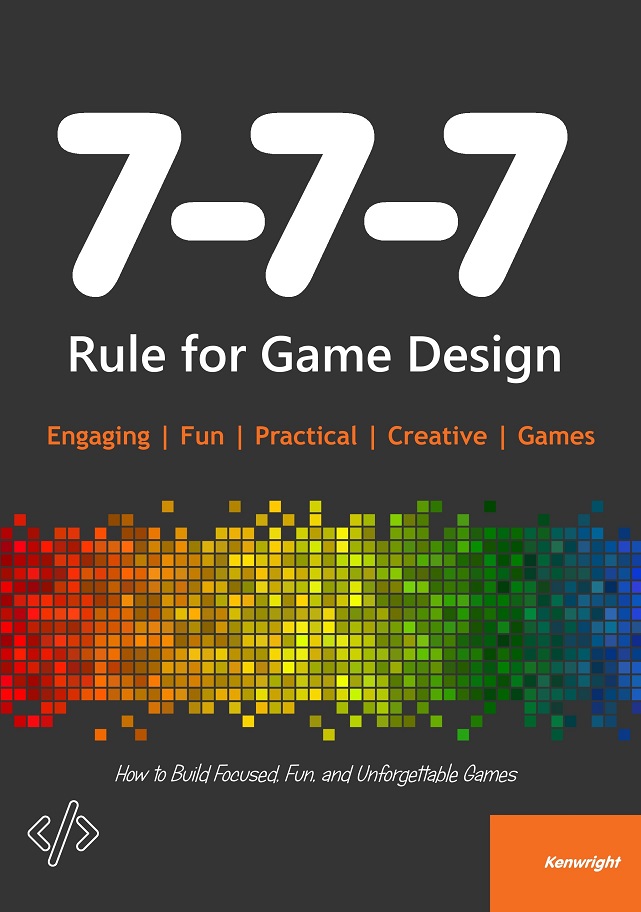
Cover of 7-7-7 Rule for Game Design (Paperback) FROM THE BOOK CATALOGUE

Game Design

7-7-7 Rule for Game Design (Paperback)

By Kenwright

A practical framework that helps game creators shape mechanics and player experiences with clarity and confidence.

WHAT THE PUBLISHER HIGHLIGHTS

  • Learn a clear framework for structuring game ideas.
  • Improve your ability to design engaging gameplay loops.
  • Develop stronger decision‑making skills in the design process.

Opens www.amazon.com. Check the retailer for current prices, formats, delivery, and availability.

Catalogue reference: 4fc8a454aa3f2849

INSIDE THE BOOK

About this book

The 7‑7‑7 Rule for Game Design breaks down the creative process into three simple layers that help designers focus on what truly matters: player goals, core mechanics, and moment‑to‑moment engagement. Through examples, exercises, and real‑world insights, the book shows how constraints can unlock creativity and lead to more polished, intentional game experiences. Whether you're prototyping your first idea or refining a complex system, the 7‑7‑7 rule offers a reliable guide for making design decisions that feel purposeful and player‑centered.

From the publisher’s description

  • Learn a clear framework for structuring game ideas.
  • Improve your ability to design engaging gameplay loops.
  • Develop stronger decision‑making skills in the design process.
  • Gain confidence through practical, repeatable design methods.

Explore the topics

ANOTHER PERSPECTIVE

Readers, in their own words

Explore reviews
Reader review3

Decent, but uneven

Not quite what I expected from the description, but there is material here.

There is a particular kind of technical book that is dense without being difficult, and this is one of them. The explanations are careful without being condescending, which is a difficult balance to strike. The writing is direct and does not waste space on filler, which I value in a technical book. Some of the diagrams are dense and I had to reread a few sections, though that may just be me. Fine, but there are stronger books on the same subject if you look around.

Adam CooperFrontend developer · Oslo, NO
7-7-7 Rule for Game Design
Reader review4

Good, but not for absolute beginners

A worthwhile addition to my shelf, with realistic expectations.

I read this over a couple of weekends alongside a small side project, which turned out to be the ideal way to approach it. Some of the material is available elsewhere, but rarely presented this clearly. I appreciated the honesty about what the book does not cover — it saved me from expecting things that were not there. The exercises at the end of each chapter are worth doing — they caught a few misconceptions I did not know I had. Solid, and I would buy another book from this author without hesitation.

Diego ClarkPhD student · Paris, FR
7-7-7 Rule for Game Design
Reader review4

Recommended, with a caveat

I got a lot out of this, even if a few sections felt rushed.

I picked this up after getting stuck on a project and it turned out to be exactly the right book at the right time. The explanations are careful without being condescending, which is a difficult balance to strike. Some of the diagrams are dense and I had to reread a few sections, though that may just be me. Worth picking up if you already have the basics. Set realistic expectations and you will get a lot out of it.

Nathan YoungCompiler engineer · San Francisco, CA
7-7-7 Rule for Game Design

BEYOND THE BOOKSHELF

News & ideas

More to explore

THE BOOKS

Your next input

View all books
Cover of Paper to Play in 20 Minutes: Rapid Game Prototyping (Game Development Concepts)
Game Development

Paper to Play in 20 Minutes

A hands-on guide to transforming game ideas into playable prototypes in just 20 minutes, focusing on rapid iteration and creative exploration.

Transform abstract game ideas into testable prototypes quickly.

Understand today. Build what’s next.

Check the publication date and ask which ideas are foundations and which are forecasts.

Explore the catalogue